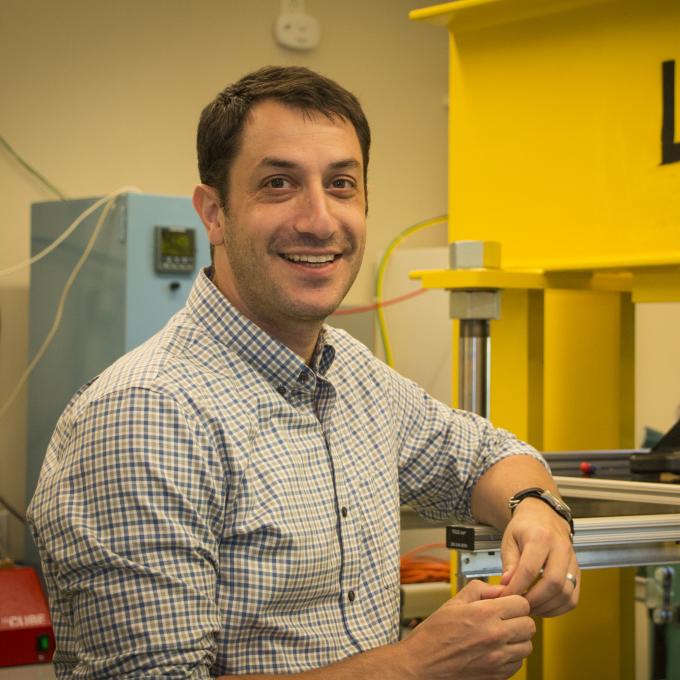

The underlying motivation for Professor Skemer's research is to understand the remarkable phenomenon of plate tectonics and its variability among the terrestrial planets.
Professor Skemer’s research interests include mantle deformation, the formation and the dynamics of plate boundaries, and the interpretation of seismological data. The underlying motivation for his research is to understand the remarkable phenomenon of plate tectonics and its variability among the terrestrial planets. Although primarily an experimentalist, his research uses the microstructures of naturally deformed rocks to infer the importance of specific deformation processes in Earth, and then develops experiments to investigate the sensitivity of these processes to a range of deformation conditions. From these experiments, one can make predictions about rock deformation at conditions or locations that are inaccessible to direct observation.
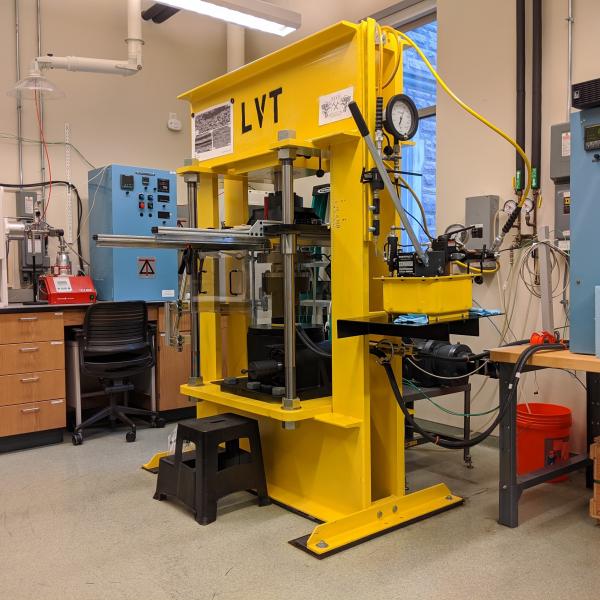
Skemer is the PI of the Rock Deformation Lab at Washington University, part of the larger Experimental Studies of Planetary Materials (ESPM) group, which includes rock deformation and experimental geochemistry. The ESPM group is also affiliated with the Institute of Materials Science and Engineering (IMSE) and the McDonnell Center for the Space Sciences (MCSS). The Rock Deformation Lab has a variety of equipment for deforming rocks at crust and upper mantle conditions. These include the Large Volume Torsion (LVT) apparatus, which twists cylindrical rock specimens to extremely large strains, and an original Griggs Apparatus for axial deformation. The lab is also in the process of building the second generation LVT apparatus, which will be capable of higher pressures, and will have greater control for more precise experiments. The ESPM group has a variety of analytical facilities at our disposal, including an Electron Backscatter Diffraction (EBSD) system for conducting microstructural studies of naturally and experimentally deformed materials and a Cameca 7f-geo SIMS instrument for high-resolution geochemical analyses.